
Stamp 6 (Irish Citizenship)
Immigration stamps allow non-EEA nationals to live, work, study, invest, and conduct business in Ireland, with each stamp carrying specific conditions. Stamp 6, also referred to as Irish Citizenship by Naturalisation, is available to individuals who have legally resided in Ireland for a required period and meet all eligibility criteria. This permission provides the opportunity to apply for Irish citizenship, granting full rights as an Irish citizen, including the ability to live, work, and study without immigration restrictions, vote in elections, and access public services. Eligibility depends on factors such as good character, lawful residence, and compliance with Irish immigration regulations.
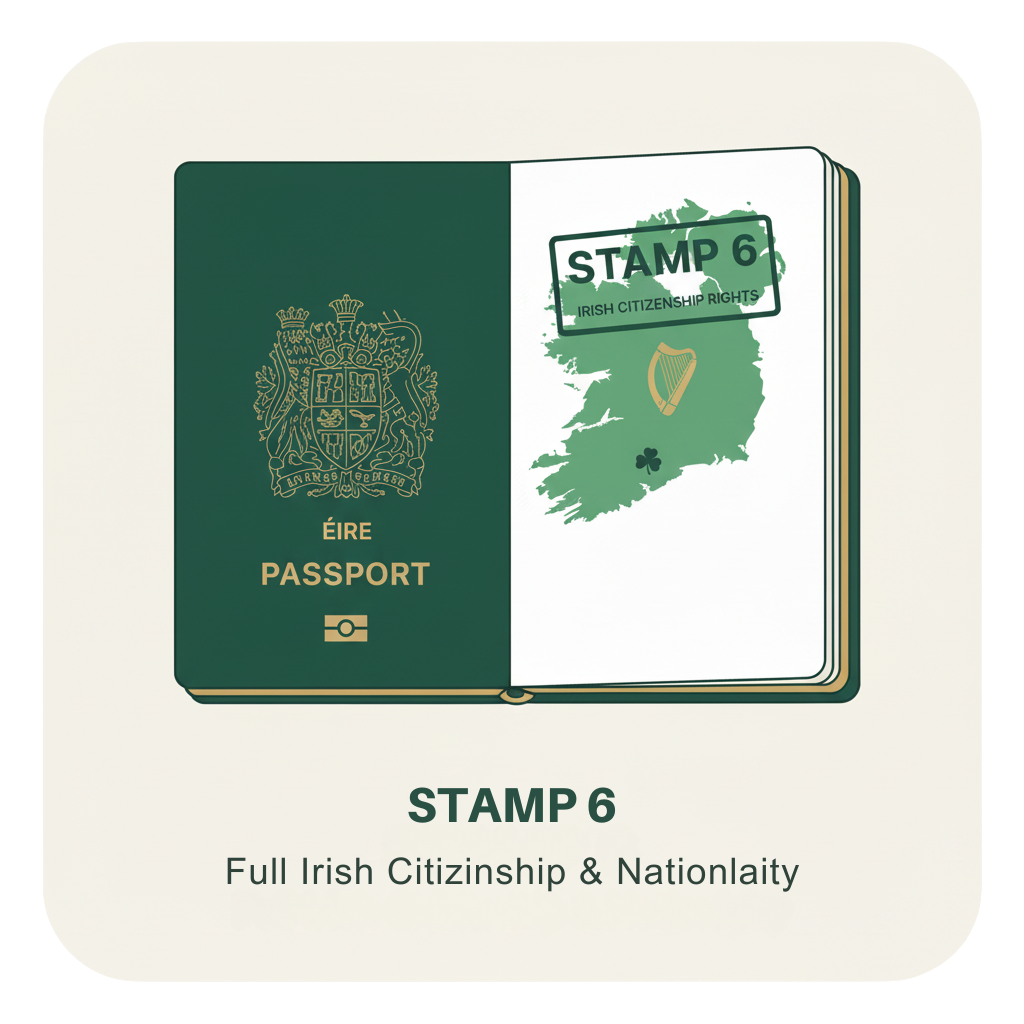
Table of Content:
Introduction
Stamp 6 grants permission to remain in Ireland without conditions for individuals who hold dual nationality or citizenship. In this context, dual citizenship refers to Irish citizenship alongside another nationality. Eligible individuals must possess, or be entitled to hold, an Irish passport.
Who Is Eligible to Apply for Stamp 6?
- By descent through their parents.
- By descent through their grandparents
- By naturalisation or post-nuptial citizenship
- By renewing existing Stamp 6 permission
If one of your parents was born in Ireland, you may be eligible for Stamp 6. The required documents include:
- Long-form civil birth certificate of your mother or father
- Mother’s civil marriage certificate if applying through her (in case of a name change)
- Applicant’s long-form civil birth certificate
- Applicant’s current passport
Applicants with grandparents born in Ireland (or elsewhere on the island of Ireland) must submit:
- Foreign births registration certificate issued by the Department of Foreign Affairs
- Current passport
Applicants naturalised as Irish citizens through post-nuptial citizenship must provide:
- Current passport
- Original certificate of naturalisation, PNC certificate, or current Irish passport
To renew Stamp 6 permission, applicants must submit:
- Expired non-Irish passport showing the previous Stamp 6 permission
- Current non-Irish passport
- Current Irish passport, if already held
Steps to Becoming an Irish Citizen Through Naturalisation
- Meet the Eligibility Conditions
- Complete the Application Form
- Gather Supporting Documentation
- Make a Declaration
- Submit the Application and Pay the Fee
Conditions for Irish Naturalisation
Age
Applicants must be at least 18 years old if applying by themselves. Adults may apply for children. Children who may be eligible are:
- Those born in Ireland after 1 January 2005 who did not automatically qualify for citizenship at birth.
- Those of Irish descent or with Irish associations.
- Children whose parent has obtained citizenship through naturalisation.
Applicants must be of good character. The application form requires disclosure of any actions or circumstances that could reflect poorly on character, with an opportunity to explain any court or police involvement. The Minister receives information from Ireland’s national police on:
- Criminal records and ongoing investigations
- Pending criminal cases
- Cautions or related warnings
- Certain civil cases, such as barring orders
- Driving offences
“Reckonable residence” refers to periods of lawful residence in Ireland that count toward eligibility. To qualify, applicants generally must have:
- A continuous reckonable residence of one year (365 days) immediately before applying.
- A total reckonable residence of four years (1,460 days) in the eight years preceding that one-year period.
-
Special rules:
- Young adults aged 18–23 who entered Ireland legally with their family can use their parents’ reckonable residence if they do not meet the requirement themselves, provided they are dependent and in school or have progressed directly to third-level education in Ireland.
- Nationals of the EEA, UK, and Switzerland do not need to calculate reckonable residence; evidence of residential history suffices. They also do not need an Irish permanent residence permit, as all periods of residence count toward naturalisation.
- Spouses or civil partners of Irish citizens may apply after three years of marriage/civil partnership and three years of reckonable residence. Refugees may apply after three years of residence in Ireland, calculated from their arrival date.
- Spouses or civil partners of Irish citizens may apply after three years of marriage/civil partnership and three years of reckonable residence.
- Refugees may apply after three years of residence in Ireland, calculated from their arrival date.
Successful applicants must continue to reside in Ireland after naturalisation and maintain their Irish citizenship, even if temporarily living abroad. They must declare fidelity to the nation and loyalty to the State. During a citizenship ceremony, applicants swear to observe Irish laws and uphold democratic values.
The Minister for Justice may waive one or more naturalisation conditions in specific cases, including applicants who:
- Are of Irish descent or have Irish associations
- Are parents or guardians applying on behalf of minor children of Irish descent or associations
- Are naturalised parents applying on behalf of a minor child
- Are spouses or civil partners of Irish citizens or naturalised persons
- Have been resident abroad while in public service
- Are recognised as refugees (under the 1951 Geneva Convention) or stateless persons (under the 1954 UN Convention)
Fees
Applicants should follow the checklist attached to the application form to ensure all required documents are included and the form is completed correctly. A non-refundable fee of €175 must be paid by banker’s draft only, made payable to the Secretary-General, Department of Justice. No other payment methods are accepted. The completed application, along with the draft, must be sent to the address specified on the form.
Processing Time for Irish Citizenship by Naturalisation
Most applications for Irish citizenship by naturalisation are processed within 12 months. During this period, applicants may be asked to provide additional documentation or clarifications. Once received, applicants will get an acknowledgement letter along with an application number. It is the applicant’s responsibility to keep the Immigration Service Delivery informed of any updates or changes.
Why Choose Visawebs?
Expert Guidance
We know Irish immigration rules inside out.
Streamlined Process
We simplify documentation and application steps.
Trusted Support
Thousands of successful student visa applications processed.
Stamp 6: Live, Work, and Thrive as an Irish Citizen.
Immigration Stamp 6 allows eligible non-EEA nationals to apply for Irish citizenship, granting full rights to live, work, study, vote, and access public services in Ireland.
Have any Questions?
Frequently Asked Questions
Can I come to Ireland to work?
What are the ways I can work in Ireland?
In general, in order to come to Ireland to work a non-EEA national must hold a valid employment permit or immigration permission.
Employment permit
All first time applicants for employment permits must make their application while resident outside Ireland. The Irish employment permit system, including the processing of these applications, is operated by the Department of Enterprise, Trade and Employment (DETE). Detailed information regarding the employment permit system can be found at the following link (DETE Employment Permit Information). If you are required to have an employment permit you must obtain a permit before you apply for a visa (if you are a visa required national) in order to travel to Ireland.
Atypical Working Scheme
Immigration permission under the Atypical Working Scheme is issued by the Department of Justice. Information on who is covered can be found here.
Working Holiday Authorisation Programme
Information on the Working Holiday Authorisation Programme can be found here. This programme allows young people to fund an extended holiday through temporary work. Only certain nationalities may avail of this programme. These programmes are currently suspended due to the COVID 19 pandemic.
Trainee Accountant
If you intend to come to Ireland to take up a position as a trainee accountant. Please click here for full details.
Minister of Religion
If you intend to travel to Ireland to work as a Minister of Religion, you will need preclearance approval before you travel. This applies to all Non EEA nationals whether you require a visa or not. Please click here for full details.
Volunteering
If you intend to travel to Ireland to Volunteer with an eligible body in Ireland, you will need preclearance approval before travel. This applies to all Non EEA nationals whether you require a visa or not. Please click here for full details.
Start up Entrepreneur Programme (STEP)
The start up entrepreneur programme (STEP) allows you to establish a business in Ireland and to work in the business on a full time basis. You are not permitted to be employed in any other capacity and you must not become a financial burden on the Irish State. You can find out more here.
Immigrant Investor Programme
The Immigrant Investor Programme (IIP) is open to non-EEA nationals who commit to an approved investment in Ireland. The IIP requires a minimum investment of €1 million, or €0.5 million (€500,000) if making an endowment, from applicant’s own resources and not financed through a loan or other such facility. You can find out more here.
I am a non-EEA national who works in another EU Member State. My employer wants me to work for them in Ireland. What do I need to know?
A non-EEA national who is legally employed by a company in an EU country may be permitted to provide services on a temporary basis to a company in another EU country, including Ireland, on behalf of his/her employer without the need to obtain an employment permit.
This is permitted under the Van Der Elst process, for more information and conditions see here. You will still be subject to Irish immigration rules and may require a visa before coming to Ireland.
I am a scientific researcher I want to come to undertake scientific research. What do I need to know?
You may be permitted to come to Ireland to carry out a research project with an accredited research institution under the Scheme for Accreditation of Research Organisations (Hosting Agreement Scheme).
Detailed information on this scheme, including on how to apply and accredited organisations can be found via the following link (DETE Hosting Agreement Scheme).
The scheme allows for a period of between three months to five years, to carry out a research project with an accredited research institution. You do not require a separate employment permit under this scheme.
You must have successfully obtained a Hosting Agreement before you apply for a visa (if you are a visa required national) and undertake travel to Ireland.
Do I need a Visa?
If you are a visa required national you must apply for a visa before travelling to Ireland. Find out if you need a visa.
What should I apply?
You can apply for all employment visa types up to 3 months before your date of travel to Ireland. You should apply for a visa as soon as possible after the granting of an employment permit/hosting agreement/immigration permission.